

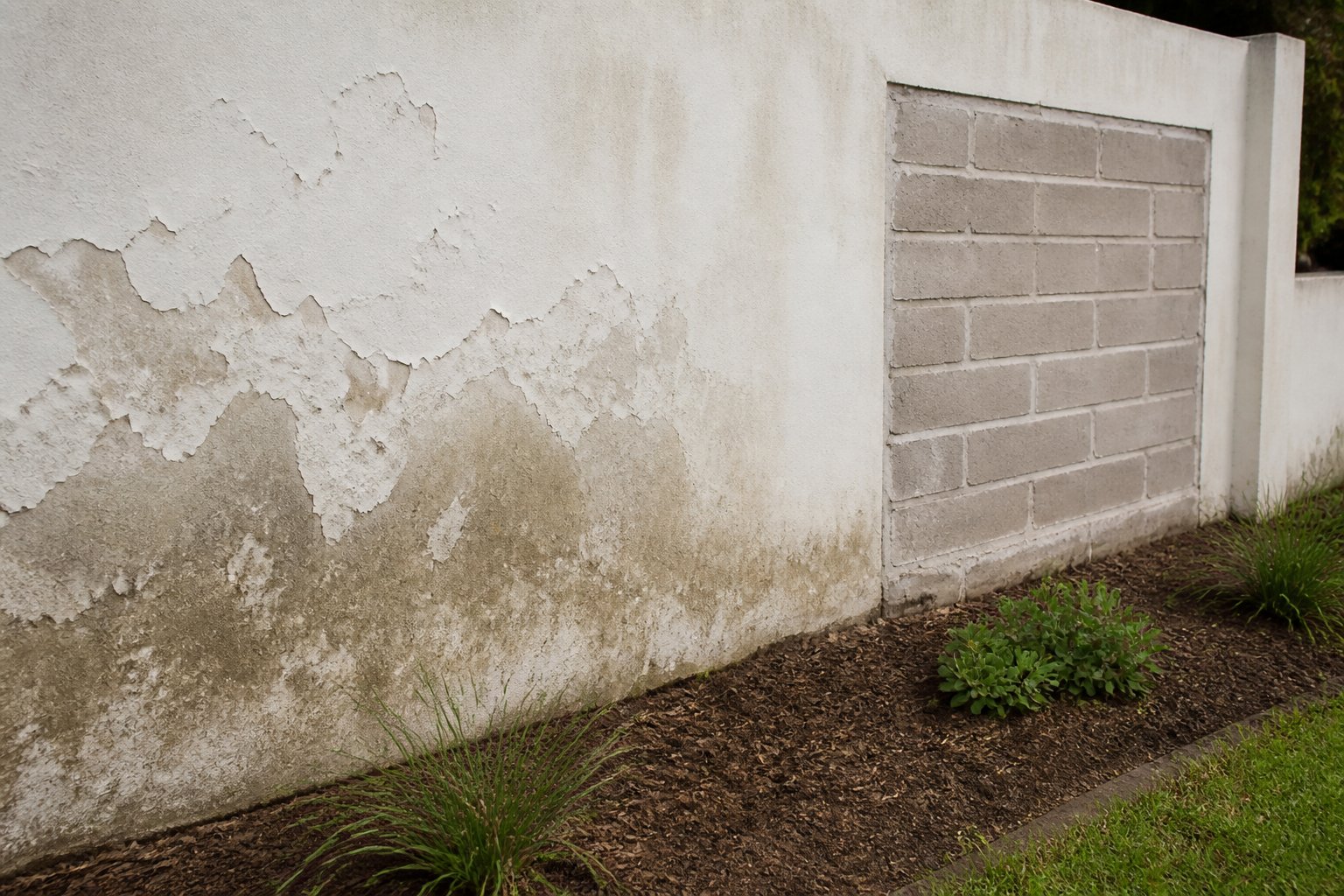
Boundary wall paint often peels for a reason that another coat cannot solve. The wall may be absorbing ground moisture, receiving daily sprinkler spray, taking water through a cracked cap, or carrying weak layers from an earlier repaint. Finding the pattern matters. If the source remains active, new paint can blister, flake or stain in the same place.
Why boundary walls fail differently from house walls
A boundary wall is exposed on both faces and often along its top. One side may face the street and full sun, while the other touches a damp garden bed or receives irrigation. Rain can enter through cracks and the wall cap. Moisture can also collect at the base where paving, soil or poor drainage prevents quick drying.
Some walls act partly as retaining structures, with soil higher on one side than the other. That creates a more difficult moisture path than ordinary weather exposure. Water pressure and persistent soil moisture can move through masonry and plaster toward the painted face. A decorative coating on the visible side cannot stop water that continues to enter from behind.
For that reason, an inspection should consider the wall as a whole. CDC Painters’ exterior painting service includes surface preparation, but the cause of active moisture should be addressed before the finishing system is applied.
Read where and when the paint peels
The location of the damage gives useful clues. Peeling concentrated along the bottom of the wall may point to ground moisture, high soil levels, repeated splashback or irrigation. Failure just below the top can suggest cracked coping, open joints or failed waterproofing on the wall cap. A narrow patch opposite a sprinkler head is more likely to be irrigation-related than a uniform band along the entire base.
Timing also helps. If the wall worsens after winter rain but improves through a dry summer, rain entry or poor drainage deserves attention. If the same area stays green, dark or damp during hot weather, check irrigation and shaded garden conditions. If peeling began soon after repainting across otherwise dry areas, poor cleaning, weak old paint or an unsuitable primer may be responsible.
These patterns are clues, not a final diagnosis. More than one cause can operate at once. Irrigation may keep the base wet while a chalky previous coating weakens adhesion higher up. A cracked cap may admit rain, and dense planting may slow drying on the garden side.
Damp, irrigation or preparation: a practical comparison
| Likely cause | Typical clues | Checks before repainting |
|---|---|---|
| Ground or lateral damp | Low-level tide marks, soft plaster, white salts, repeat failure | Soil height, drainage, retaining conditions and moisture movement |
| Irrigation overspray | Local wet patches, algae, damage aligned with sprinkler reach | Run the system and watch where water lands or pools |
| Failed wall cap or coping | Peeling and streaks below the top, cracks on the horizontal surface | Joints, coping, waterproofing and water-shedding detail |
| Poor preparation | Peeling across dry areas, paint lifting from chalk or loose old layers | Adhesion, surface powder, contamination and primer choice |
| Cracked plaster | Failure follows crack lines or hollow, friable patches | Crack depth, plaster condition and possible movement |
White powder is often mistaken for ordinary dust. On masonry it may be efflorescence, which forms when moisture carries soluble salts to the surface. Repainting over it without dealing with the moisture source commonly leads to another failure. CDC Painters offers damp-proofing preparation in Cape Town where wall moisture must be assessed before painting.
How irrigation damages a boundary wall
Sprinklers can wet a wall more frequently than rain does. A short watering cycle repeated through the week may keep plaster damp near the base, especially in shade. Water can enter hairline cracks, soak porous masonry and feed algae. Garden beds placed directly against the wall can hold moisture against it long after irrigation stops.
The simplest check is to run each irrigation zone and observe it. Look for spray hitting the wall, leaking fittings, water pooling near the footing, and runoff trapped between paving and masonry. Adjusting sprinkler direction or timing may help, but leaks, poor drainage and high soil levels may need separate attention. Plants should not conceal the wall so completely that early cracks and damp patches go unnoticed.
A planter or retaining section needs extra caution. If the soil-facing side lacks effective waterproofing or drainage, access to the source may be limited. The correct response may involve a landscaping, drainage or waterproofing specialist. A painter should not promise that a face-side coating will overcome constant moisture pressure from behind.
Wall caps, cracks and drainage can feed the problem
The top of a boundary wall receives direct sun and rain. Flat or cracked caps can hold water instead of shedding it. Open joints around coping units and small cracks in the upper plaster give water a path into the wall. Damage may then appear lower down, which can make the source easy to miss.
Inspect both faces of the wall and the full top surface. Look for cracks, loose coping, failed joints, hollow plaster, blocked drainage routes and staining below the cap. Small defects may be suitable for painting-related preparation, while failed waterproofing or significant masonry movement needs the appropriate trade.
Cracks should not all be treated as simple filler work. Their direction, width and recurrence help determine what repair is reasonable. CDC Painters handles crack repairs and plaster preparation associated with painting. Widening, stepped or repeatedly moving cracks should be referred for specialist assessment before repainting.
Failed preparation has its own warning signs
Not every peeling wall has active damp. Paint can detach because the previous surface was dusty, chalky, dirty or unstable. It may also fail where loose old coatings were feathered poorly, bare plaster was not primed correctly, or mould and algae were covered rather than treated.
An adhesion problem often reveals itself when several layers lift together. The underside of a flake may carry powder or remnants of an earlier weak coating. Peeling may occur across exposed dry sections instead of following a damp line. Even then, the wall should still be checked for moisture because poor preparation and damp often overlap.
Sound preparation normally means removing all loose material, cleaning contamination, allowing the surface to dry, repairing defective plaster, sanding firm edges and using a primer compatible with the substrate. The topcoat should only go onto a clean and stable base. Adding more coats over a weak layer increases film thickness but does not strengthen the bond below.
A repair sequence that reduces repeat failure
- Inspect the top, base and both faces of the wall.
- Note the height, shape and timing of damp or peeling patches.
- Run irrigation and check overspray, leaks and pooling.
- Assess soil levels, drainage, planters and retaining sections.
- Repair water entry through caps, joints or cracks where appropriate.
- Allow wet masonry and repairs enough time to dry.
- Remove loose paint, salts, algae, chalk and weak plaster.
- Prime and repaint with a system suited to the prepared surface.
The sequence may change after inspection. A wall with active lateral damp needs a different scope from a dry wall with poor adhesion. Waterproofing is also location-specific: coating the street-facing side will not necessarily address water entering from a garden bed. CDC Painters provides waterproofing services in Cape Town where the defect falls within the painting and waterproofing scope.
Large complexes and shared boundaries also need clarity about which side can be accessed, who controls irrigation and how repairs will be phased. The body corporate painting service is relevant to trustees and property managers planning common-area work. For a site-specific assessment, contact CDC Painters with photographs and details of when the peeling becomes worse.
Frequently asked questions
Why does my boundary wall keep peeling after repainting?
The new paint may be attached to a damp, contaminated or unstable surface. Common causes include moisture from soil, irrigation, failed wall caps, salts, chalky old paint and weak plaster. The pattern should be diagnosed before another repaint.
Can sprinkler water really make paint peel?
Yes. Repeated overspray can keep masonry wet, encourage algae and move through cracks or porous plaster. Adjusting the sprinkler helps only if leaks, pooling, drainage and soil contact are also checked.
What does white powder on a boundary wall mean?
It may be efflorescence, a salt deposit left as moisture moves through masonry and evaporates. The deposit should be removed, but its presence also calls for an investigation into the moisture source before painting.
Will waterproof paint stop damp from behind the wall?
Not necessarily. A coating on the visible face may fail if water continues entering from soil, a planter or a retaining side. Effective treatment depends on where the moisture comes from and whether that side of the wall can be accessed.
How dry must the wall be before repainting?
The wall must be suitably dry for the selected primer and coating system. Drying time varies with wall thickness, shade, weather and the amount of moisture present, so a fixed number of days is not reliable without assessing the site.
More practical exterior and preparation guides
Continue with closely related guidance, then review the relevant Cape Town service page.
Discuss your painting requirements
Review CDC Painters services or request a project-specific quotation.