

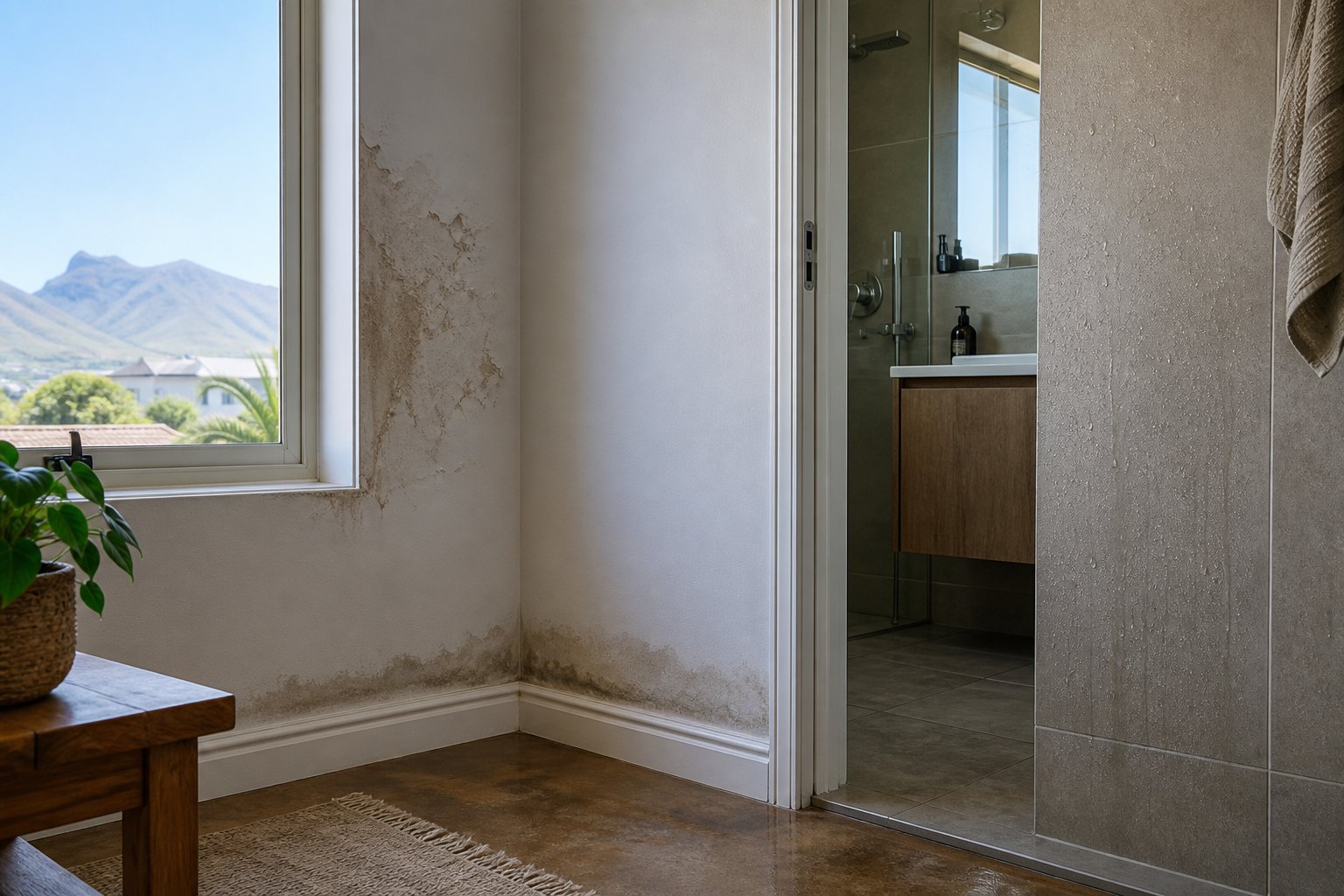
A dark patch on a wall does not identify its own cause. Rising damp, penetrating damp and condensation can all leave stains, peeling paint or mould, yet each involves a different moisture route. Cape Town’s wet winters, coastal exposure and varied housing stock make careful diagnosis especially important. Treating the visible paint failure without correcting the moisture source usually leads to repeat damage.
Three moisture problems with different causes
Rising damp is moisture moving upward through porous masonry from the ground. It is associated with a missing, bridged or ineffective damp-proof course and generally affects the lower part of ground-floor walls.
Penetrating damp is water passing through the building envelope from outside or from a local building defect. Rain can enter through cracks, failed joints, parapets, roof details, window surrounds or deteriorated exterior finishes. Plumbing leaks can produce similar local symptoms but are a separate source that must also be ruled out.
Condensation forms when moisture in indoor air meets a sufficiently cold surface. It commonly appears on windows, cold external walls, behind furniture and in rooms where moisture is generated but ventilation is limited.
These categories can overlap. A room may have rain penetration and poor ventilation, or a damp wall may be cold enough to encourage surface condensation. CDC Painters’ damp-proofing service in Cape Town starts from the principle that the cause must guide the preparation and treatment.
How rising damp usually presents
Rising damp begins at ground level and moves through capillaries in brick, mortar or plaster. Its height and severity vary with the materials, evaporation and the moisture source, so there is no reliable single line that proves the diagnosis. However, the location offers useful clues.
Look for damage concentrated along the base of a ground-floor wall: blistering paint, crumbling plaster, powdery salt deposits, dark skirtings or a horizontal tide-like edge. The symptoms may continue across part of a wall rather than forming one isolated patch. Outside ground levels, paving or plaster that bridges the damp-proof course can contribute to the problem.
A moisture reading on its own does not establish rising damp. Salts can affect some meters, and wetness at the bottom of a wall can also result from rain splash, a leaking pipe, poor drainage or water trapped beside the building. Investigation should consider ground levels, wall construction, services and external exposure before a treatment is selected.
How penetrating damp usually presents
Penetrating damp often has a stronger relationship with weather or a specific defect. A patch may become darker after north-westerly winter rain, appear around a window reveal or track down from a parapet. On another property, it may follow a roof-wall junction or a crack in an exposed elevation.
Unlike rising damp, penetrating moisture is not restricted to the base of the wall. It can occur at any height, including upper floors and ceilings. The visible patch may also be offset from the entry point because water travels behind plaster, through cavities or along structural elements.
External checks may reveal cracked render, open joints, failed sealant, blocked drainage routes or peeling coatings. Suitable non-structural defects may form part of crack and plaster preparation, followed by compatible waterproofing work. Widespread movement, damaged building components or uncertain structural cracking should be assessed by the relevant specialist rather than hidden under filler or paint.
How condensation usually presents
Condensation is driven by indoor humidity, surface temperature and ventilation. Everyday activities such as cooking, showering and drying laundry release moisture into the air. When that air reaches a cold window, wall or ceiling, water condenses on the surface.
Common clues include droplets on glazing, black or green mould in corners, speckled growth on ceilings, dampness behind cupboards and symptoms that are worse in occupied bedrooms or bathrooms. Marks may reduce when windows are opened regularly or when moisture generation decreases. Condensation can be seasonal because wall and glass surfaces are colder in winter.
Anti-mould or moisture-resistant paint may help protect a correctly prepared surface in an appropriate room, but paint does not remove excess indoor humidity. Ventilation, extraction, heating patterns, furniture spacing and the source of moisture all need attention. Persistent mould should be handled carefully, particularly where occupants have health concerns.
Compare the clues before choosing a repair
| Clue | Rising damp | Penetrating damp | Condensation |
|---|---|---|---|
| Typical position | Base of ground-floor masonry | Any height near an external defect or water route | Cold surfaces, corners, glazing and areas behind furniture |
| Timing | Can remain persistent | Often worsens during or after rain | Often worse in cold weather or after moisture-producing activities |
| Common surface signs | Salt deposits, damaged plaster, peeling at low level | Local stains, blistering, peeling or wet patches | Droplets, surface mould and speckled staining |
| Main investigation | Ground levels, damp-proof course, drainage and services | Cracks, joints, roof or parapet details, windows and exterior coatings | Humidity, ventilation, extraction, heating and cold surfaces |
| Why repainting alone fails | Moisture and salts remain in the wall | Water continues entering through the defect | Humidity continues reaching cold surfaces |
Do not force the evidence into one category. If a stain appears only after rain but sits low on the wall, penetrating damp or rain splash may be more likely than true rising damp. If mould forms on an externally damp wall, both penetration and condensation may be contributing.
A sensible diagnosis and repair sequence
- Map the symptoms. Photograph the area, mark its boundaries and note the weather or activity that preceded it.
- Check nearby sources. Consider plumbing, roof and gutter details, window joints, exterior cracks, ground levels and ventilation.
- Assess both sides of the wall. An internal paint defect may correspond with a failed exterior surface. CDC Painters’ exterior painting services include the preparation needed before a suitable exterior coating is applied.
- Correct the moisture route. This may mean damp-proofing, local waterproofing, plumbing work, drainage changes or improved ventilation, depending on the diagnosis.
- Allow materials to dry. Drying time depends on wall thickness, weather, ventilation and the amount of moisture. Covering a damp substrate too quickly can trap moisture and spoil adhesion.
- Remove unsound finishes and salts appropriately. Loose paint and damaged plaster need to be taken back to a stable surface. The repair system must suit the substrate and residual salt conditions.
- Prime and repaint. Only then should compatible preparation products and finish coats be applied. For affected living spaces, see the interior painting service.
Where the cause remains uncertain, obtain a site assessment rather than relying on appearance alone. A painting contractor can identify coating and preparation issues, while plumbing, roofing, drainage or structural concerns may require the relevant specialist. Property owners can contact CDC Painters to discuss damp-related preparation, waterproofing and repainting requirements.
Frequently asked questions
Can rising damp occur on an upstairs wall?
True ground-sourced rising damp is associated with moisture moving upward from the base of a building, so an upstairs patch points towards another source. Check rain penetration, plumbing, roof details and condensation instead.
Does black mould always mean condensation?
No. Surface mould often develops where condensation keeps a surface damp, but it can also grow on a wall affected by penetration or another moisture source. The location, timing, ventilation and condition of the exterior should all be considered.
Why does damp paint bubble again after repainting?
The moisture route may still be active, salts may remain in the wall, the substrate may not have dried or incompatible products may have been applied. New paint cannot correct an unresolved building or humidity problem.
Can waterproof paint solve every damp wall?
No. A coating must suit the substrate and the direction from which moisture is arriving. Coating the room side of an actively wet wall can trap moisture or shift the visible failure without correcting the entry point.
How long should a damp wall dry before painting?
There is no universal number of days. Drying depends on the source, saturation, wall construction, temperature and ventilation. The moisture cause should be corrected first, and the surface assessed as suitable before preparation and repainting.
More practical roof, damp and waterproofing guides
Continue with closely related guidance, then review the relevant Cape Town service page.
Discuss your painting requirements
Review CDC Painters services or request a project-specific quotation.